
Towns
Layout
Section titled “Layout”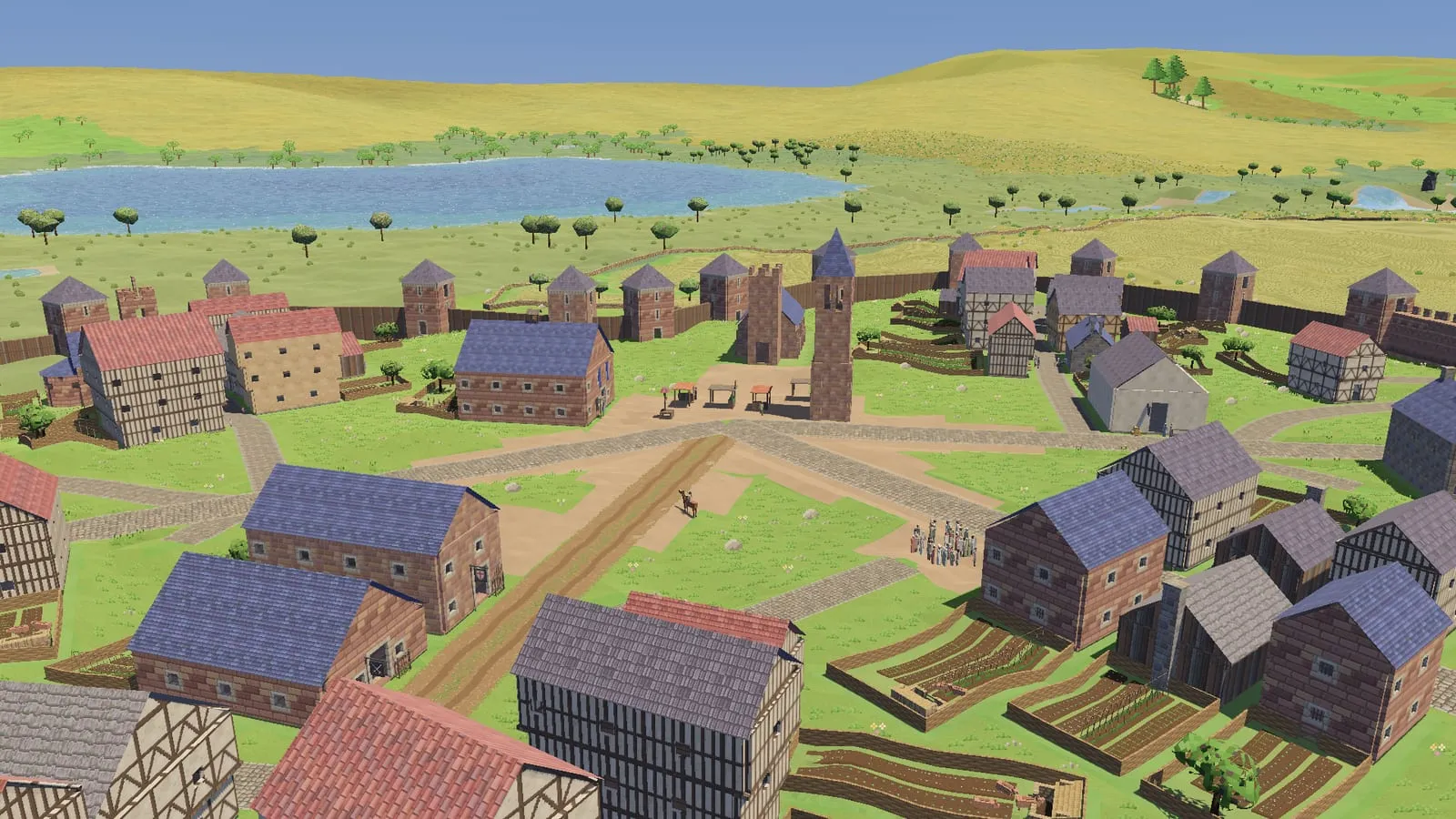
A town has 30 to 80 buildings. It is grown, planned on a grid, or laid along one market street. Every road runs in to the market as a main street, and narrow plots line the streets. The temple stands on a square off the market; the richest tenth of towns have a high temple.
| Wall | Share of towns |
|---|---|
| All stone, 6 m high | The richest third |
| Stone in part, palisade elsewhere | The next third |
| Palisade, 4 m high | The rest |
Each wall has towers and a gate at every main street. Suburbs run out 60 m from each gate, and a gallows stands by a road out. Gates shut for the curfew, two hours after dusk until dawn.
A town within 0.6 km of the sea has a harbour: a stone quay on its shore with steps, a ramp and a lane into town. The biggest isles each have a small town, reached only by ship. See Sailing.
Colour goes with wealth. Houses are painted (lead yellow, ochre, crimson, vermilion, verdigris, and ultramarine in the richest), and bunting hangs across the streets all year. The folk are dressed by their place’s wealth too: the rich in ultramarine and crimson, villagers in homespun with one bright piece.
Castle towns
Section titled “Castle towns”Half the towns grow below a castle, 260 to 380 m from their market, wrapped round the foot of its rock. The kingdoms’ capitals never do. A straight street climbs from the market to the castle gate, and the town’s wall and the castle’s close one circuit. On the map the pair is one icon and one name.
A castle town is always of its castle’s kingdom and owes that castle. Raiders pass it by and go for the castle. When the castle is taken, or its castellan defects, the town goes with it. It cannot drift free until its castle has been taken once.
Shops and services
Section titled “Shops and services”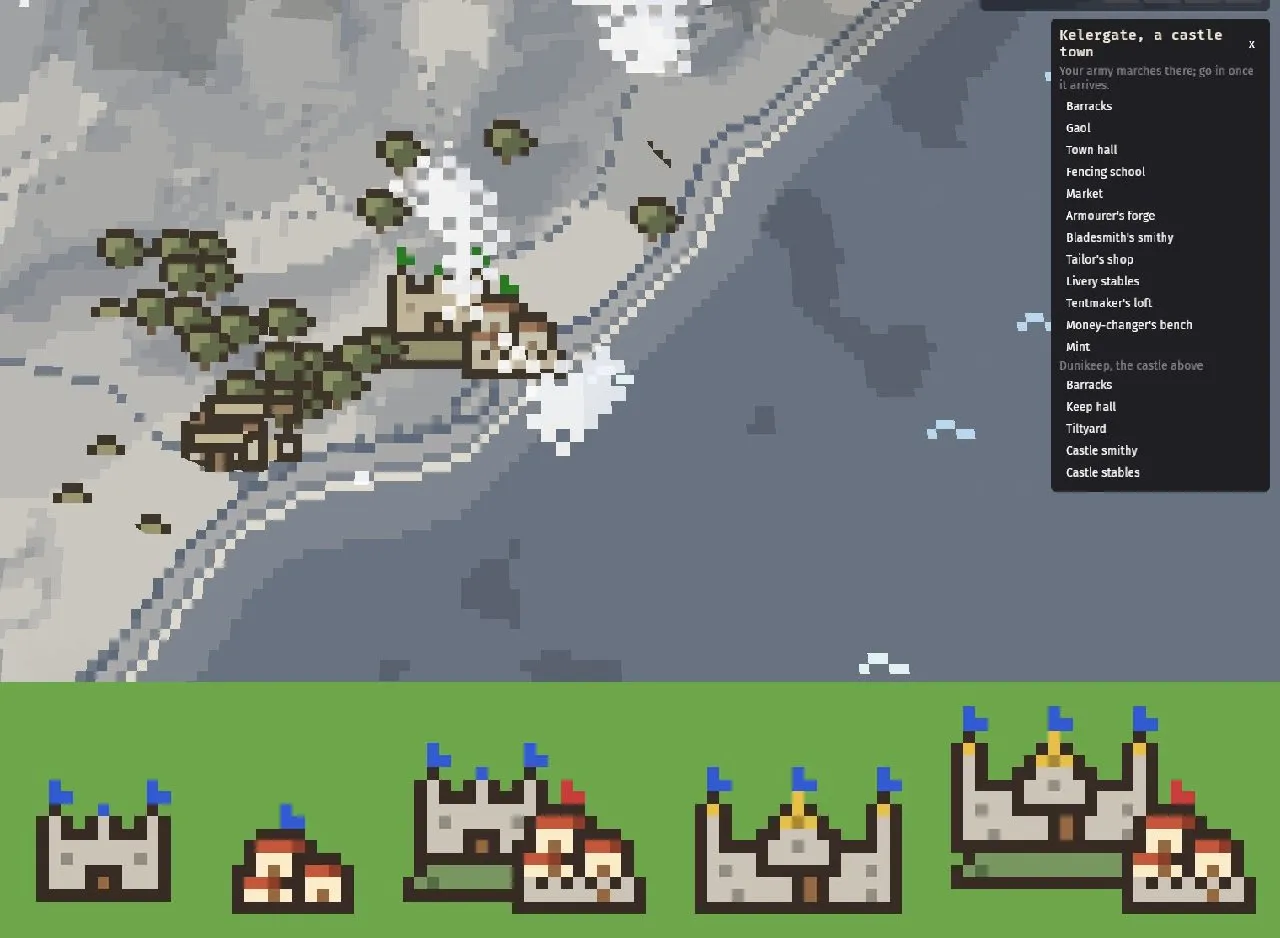
Each tab stands behind a building’s door. Press F at the door, or click the town on the map and pick a building.
| Building | Tab | What it does |
|---|---|---|
| Barracks | Garrison | Hire the town’s militia |
| Gaol | Gaol | Bounty on bandits’ heads; sell prisoners |
| Town hall | Jobs, Heads | The job board; the town’s heads |
| Alchemist’s shop | Alchemist | Skill and attribute potions |
| Market | Market | Buy and sell goods |
| Armourer’s forge | Armourer | Helmets, mail, plate, shields, barding, packs |
| Smithy | Weaponsmith | Spears, swords, axes, bows, lances |
| Tailor | Tailor | Coifs, padded jacks, surcoats, gloves, shoes |
| Livery stables | Stables | Mules, wagons, spare horses |
| Tentmaker | Tentmaker | Tents, bedrolls, firewood |
| Money-changer | Changer | Change coin |
| Mint | Mint | Swap called-in pennies for new silver |
Prices and how they move are on Economy. Game time stops while a place’s screen is open, unless you turn Pause on screens off in Options.
Garrison
Section titled “Garrison”Every town keeps a militia for hire: 20 infantry, 10 ranged and 4 cavalry, refilling 4, 2 and 1 a day. They are townsmen by name, hired one by one like the men at an inn. Their gear is a tier better than inn men’s, and they cost half as much again. Wages are the same. The coin goes into the town’s coffers.
Any town not at war with you pays 40 silver for each bandit’s head your army has taken. The gaoler also buys common prisoners: 32 silver a spearman, 40 an archer, 80 a horseman, half for a wounded man. Sold prisoners go free and wait at the nearest inn or garrison for hire. A castle has no gaol.
Free and bound
Section titled “Free and bound”A town drifts between free and bound to the castle that claims it, a tenth of the way each day: its kingdom’s men within 10 km against the town’s own militia and wealth. A free town keeps its taxes and sends no men when the banners are called.
Fairs and markets
Section titled “Fairs and markets”Discday is market day. Each town holds a fair one week a year. See Calendar.
Shelter
Section titled “Shelter”A night inside a welcoming town’s walls is a night under shelter: full rest whatever the weather. Wounded men heal twice as fast there.
Buildings
Section titled “Buildings”Alchemist’s shop, Alehouse, Almshouses, Armourer’s forge, Barracks, Bathhouse, Bell tower, Bladesmith’s smithy, Brewhouse, Cemetery, Cloister temple, Dyehouse, Fish market, Gallows, Gaol, Gate, Guildhall, High temple, House, Livery stables, Market hall, Market stalls, Mint, Money-changer, Pillory, Quay, Shambles, Storehouse, Tailor’s shop, Tannery, Temple, Tentmaker’s loft, Thieves’ den, Toll booth, Tower, Town hall, Wall, Well, Workshop.