
Sailing
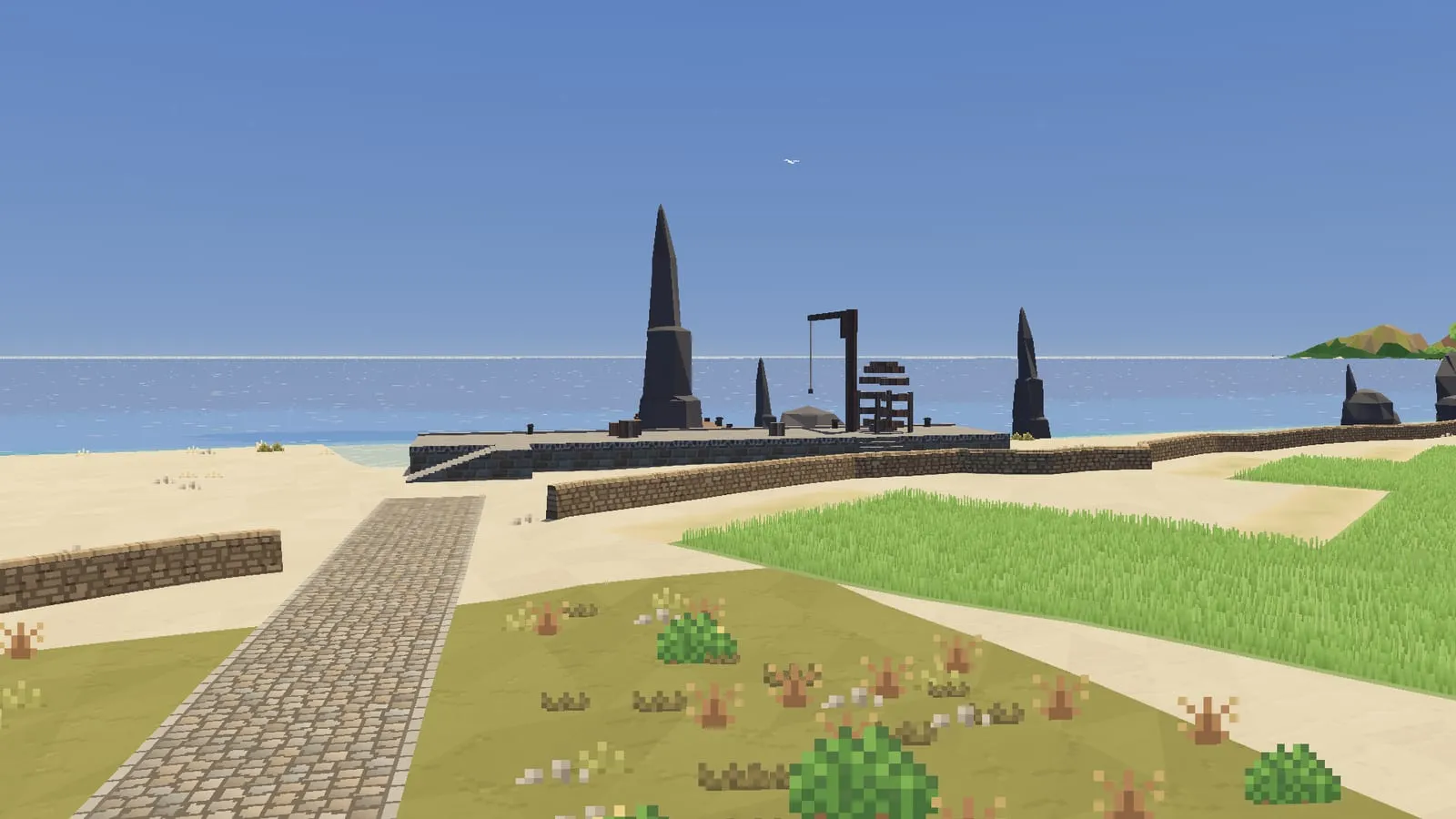
There are four kinds of ship:
| Ship | Length | Beam | Draws | Crew | Cargo | Map pace | Puts out in waves up to | Rowed |
|---|---|---|---|---|---|---|---|---|
| Barge | 16 m | 4.5 m | 0.6 m | 3 | 15 t | 1.5 m/s | 0.5 m | No |
| Fishing boat | 7 m | 2.4 m | 0.5 m | 3 | 1 t | 2 m/s | 1 m | Yes |
| Cog | 24 m | 7.5 m | 2.2 m | 15 | 80 t | 2.5 m/s | 3 m | No |
| Longship | 25 m | 5 m | 0.8 m | 40 | 5 t | 3.5 m/s | 1.5 m | Yes |
A barge is a flat river boat with a sweep and a small sail. A fishing boat is open, with a sail, a pair of oars and a steering oar. A cog is decked, with castles fore and aft, one great sail with a fighting top and a stern rudder. A longship is long and low, with 16 oars a side and shields along its rail.
Ships cannot be bought or built yet.
Steering
Section titled “Steering”You steer your own ship like a horse. Stand by her side and press E to take the helm; press it again to step ashore onto dry ground alongside.
| Key | Does |
|---|---|
| W, S | Step her way up or down, one step a press: backing water, oars shipped, rowing, rowing hard on a rowed ship; sail furled, half sail, full sail on a cog or barge |
| A, D | Put the helm over while held; it comes back amidships when let go |
She gathers way and loses it over a few seconds, a long ship more slowly. She turns faster the faster she goes and the shorter she is, and not at all lying still. She needs 0.3 m of water under her keel at bow, middle and stern, the tide counted on the sea; where she would touch, she runs aground, and you can back her off. You stand aft at the helm and move with her, and your horse comes too. Let go, and she drifts to a stop.
On the map
Section titled “On the map”Taking the helm puts your army aboard. Zoomed out, it sails at its ship’s pace by sea, lake or deep river, never over land. A route that ends on land puts it ashore there, and it keeps its ship. Bad weather slows a ship to no less than three tenths of its pace.
| Weather | What happens |
|---|---|
| Waves over what the ship puts out in | It lies where it is until they fall |
| Wind under 1.5 m/s | A cog or barge lies becalmed; a fishing boat or longship rows on |
Men aboard do not come out onto the field. Armies afloat and armies ashore never fight each other.
The isles
Section titled “The isles”Every piece of dry ground but the continent is an isle. The biggest isles have small towns, a few have a castle, and fishing villages stand by their shores. No road reaches an isle, and isle villages owe their isle’s castle.
Towns within 0.6 km of the sea have a harbour with a stone quay, and every isle place has a landing. An army bound across the sea, yours or anyone’s, marches to the nearest harbour, sails the sea lanes to the harbour nearest where it is going, lands and marches on. With no ship of its own it takes passage on a cog, at 20 silver a man paid to the harbour’s town. Click an isle on the map and your army goes to take ship. Where neither side has a harbour, nobody goes.
Trade by sea
Section titled “Trade by sea”A harbour town with 24 gold to spare keeps a merchant cog at sea, with 12 sailors and 3 archers. It sails to another harbour town within 60 km by sea, sells its cargo, buys what pays best at the next port, up to 20 tonnes, and comes home with its coin after four ports. It sails through the night and lies still in a storm or a calm. In all else it trades as a caravan. See Parties.
Pirates
Section titled “Pirates”One isle harbour in three has a pirates’ cove off it. Pirates put out in a longship, 15 to 30 men, and lie in wait at a bend of a sea lane near their cove. They fall on any ship they outnumber that comes within 1.5 km, a merchant cog or an army afloat, yours too, and take their loot home. They never go ashore, and nobody ashore hunts them.
Sinking
Section titled “Sinking”A ship is built of timber parts: keel, hull runs, decks, mast, yard, sail, castles, rudder, oars and shields. They break and burn by the same rules as walls. Knock out a part and whatever it alone held up falls with it, so a felled mast brings down its yard and sail. A sail burns through in a minute and timber in four, and what lies under the water does not burn.
A battered hull leaks, and a hull run knocked out opens all its face. Water comes in below the waterline by the hole’s size and depth, runs to that side and lists the ship towards it. As she fills she settles. When her gunwale goes under she founders, or past 55° of heel she capsizes. Then she goes down to the bottom and stays there as a wreck.
The crew fight it. Each man bailing throws out 4 litres a second, and each man plugging stops 20 cm² of hole a second. A fist-sized hole in a laden longship sinks her within the hour if left; twenty men bailing keep her up.
Over its waves, a ship’s seams start to leak and green water comes over her side; a decked cog keeps most of it out. A fishing boat caught in a storm goes down, and a cog rides out a gale with her crew bailing.
When an army’s ship goes down, from fire, holes or the sea, the army loses her. Ashore, only the ship is gone. Afloat, the hold, the train and its beasts go down with her, and the men swim for the nearest dry ground: a fifth drown close in, more the farther out, and all of them 1.5 km out. You come ashore alone if your men are all lost.
Fights at sea
Section titled “Fights at sea”Two armies afloat that fight near you come out on the field, each crew on its own ship. The ships are lashed side by side and lie still while the fight lasts, and the crews fight across the rails as on land, from a cog’s high deck down to a longship’s low one. Far from you, a fight between ships is settled on the map.
There is no grappling yet, the rails do not stop a shove over the side, and nobody swims: a man in the sea stands on its bed.
The sailing skill
Section titled “The sailing skill”The sailing skill does nothing yet.