
Castles
There are 34 castles on the standard disc, at least 3.3 km from any town or castle. They take high ground, river crossings and the land halfway between towns. Their walls bend to the high ground. A castle by a river or lake stands on its bank, its walls cut along the water and its moat fed from the river. The biggest isles have a castle or two.
Castle rocks
Section titled “Castle rocks”About half the castles, the hilliest and those over castle towns first, stand on a castle rock lifted out of the land, with near-sheer faces all round. A rock is one to four levels high, most often two, each level 6 m (8 m in the hills). Each level is a plateau with its own sheer edge inside the one below, like terraces: the keep’s ward stands on the top and each ward out from it a level lower. A level with no ward is an open terrace. On one side the rims stand flush, one sheer face from top to foot.
Ramps climb one level at a time along the face above them, straight, switchback or spiral, with a level landing at the head. The castle’s road climbs them to the gate; inside the walls a steeper ramp climbs from each ward to the next. A big rock has up to two more paths up its sides. A castle on a rock has no moat, and a castle town gathers round its foot.
Size by wealth
Section titled “Size by wealth”A castle’s wealth comes from the villages within 5 km, plus some luck.
| Wealth | Share | Plan |
|---|---|---|
| Poorest | A quarter | One ward 30 to 50 m across, in a palisade |
| Middling | About a third | 75 to 120 m |
| Rich | A quarter | 120 to 180 m, twin-towered gatehouses and a barbican |
| Richest | The rest | Three or four wards, some in rings |
A quarter of the richest are grand, 225 to 270 m, with a tilt yard and gardens. Each kingdom’s biggest castle is its seat.
Walls stand about three storeys high, a storey lower on half the middling castles and higher on half the rich. Towers and gatehouses stand a storey higher than the walls. The keep is about 12 m across and four storeys high.
The pieces
Section titled “The pieces”Every castle is built of the same pieces. Each piece is made of parts that can be broken one by one in a siege.
| Piece | Size | What it is |
|---|---|---|
| Curtain wall | 3 m thick, 3 storeys (9 m) | The wall between towers, laid in lengths of up to 4 m, with a walk behind battlements |
| Palisade | A timber wall in place of stone, round the poorest castles | |
| Square tower | 8 m and up | At the turns of the wall or along it |
| Round tower | 9 m and up | At the turns of the wall |
| D tower | 8 m and up | Along the wall: square inside, round outside |
| Arch gate | 8 m along the wall | A gate through the curtain, with the road through its arch |
| Gatehouse | 16 by 10 m | A gate between twin towers, with the road through its passage |
| Barbican | Reaches 12 m out | Walls in front of a gatehouse |
| Palisade gate | The way through a palisade | |
| Keep | 12 m, 4 storeys | Square or round, standing free or built into the wall |
| Shell keep | A wall round a small court, in place of a keep | |
| Range | A long hall built against the inside of the curtain | |
| Garderobe tower | 3 by 3 m | Against the outside of the wall, toward the back |
| Dungeon | 2.6 by 2.6 m | A barred cell in a corner of the keep’s ground storey |
Towers and gatehouses stand a storey above the walls. A tower’s top storey is open on the inside, so the wall walks run through it from either side. Stairs climb to the walks and to the tower doors.
How a castle is put together
Section titled “How a castle is put together”Each castle is laid out from its own seed and its wealth, in this order:
- Wards. Wealth sets how many wards (walled yards) it has and how they lie. A castle may have one ward. It may have a chain of wards along a ridge, with the inner ward at the high end. It may have two wards side by side across the way in. Or it may have rings inside rings, which only the richest have. About two thirds of middling castles and a third of rich ones have one ward. Two in five rich castles with two wards have one more wall round both. The inner ward never faces the road.
- Outline. Each wall is fitted to the ground. Most one-ward castles are lopsided, up to two and a half times longer one way than the other. The wall’s turns shift up to 6 m to keep to the high ground. Rings stand about 16 m apart, with room to ride between their towers. A ward never reaches into a river or lake: it stands back, with its wall along the bank. Where the ground drops 12 m just outside, the cliff can stand in for a stretch of wall. If the plan does not fit, it is tried smaller, or with one ward or one ring fewer.
- Gates. The poorest have a palisade gate. Half the middling have an arch gate and half a gatehouse. The rich have a gatehouse with a barbican. Each wall between wards has its own gate, set at least 6 m off the line in through the gate before, so nobody can charge straight through. The richest have a second way in on the far side. A castle over a town opens its main gate onto the town’s street and has a field gate to the open ground.
- Keep. The keep goes in the innermost ward, on its highest ground. Three in five keeps are square, a quarter round and the rest shell keeps. Three in five square or round keeps are built into the wall. A keep is 0.85 to 1.25 times the usual size. A seat’s keep is 1.3 times.
- Towers. A tower stands at every turn of the wall except where the keep is. Two in five castles have round towers there and the rest square ones. They are bigger on richer castles, up to 13 m. Two in five castles have towers only at the turns. The rest add towers along long stretches about every 24 m, clear of the gates, half of them D towers.
- Curtain. Curtain fills the wall lines between towers and gates. Where water or a cliff guards a whole stretch, that stretch is left unbuilt.
- Inside. Ranges go in first, with their backs to the wall: one in a middling castle, two in a rich one, three in the richest. A grand castle lays out a 48 by 12 m tilt yard in its biggest ward and gardens in the inner ones. The other buildings line the walls facing in. The smallest yard holds six, and each 900 m² of yard adds one more. They keep clear of the ways between the gates, the way to the keep, and the middle of the ward, which is left open for mustering. A seat adds its palace hall, household lodgings, great stable, menagerie and minster.
- Last touches. The dungeon goes in the keep. The garderobe tower goes on the farthest stretch of wall from the gates. Then come the castle’s own roofs, turrets and hoardings (see below).
Each its own
Section titled “Each its own”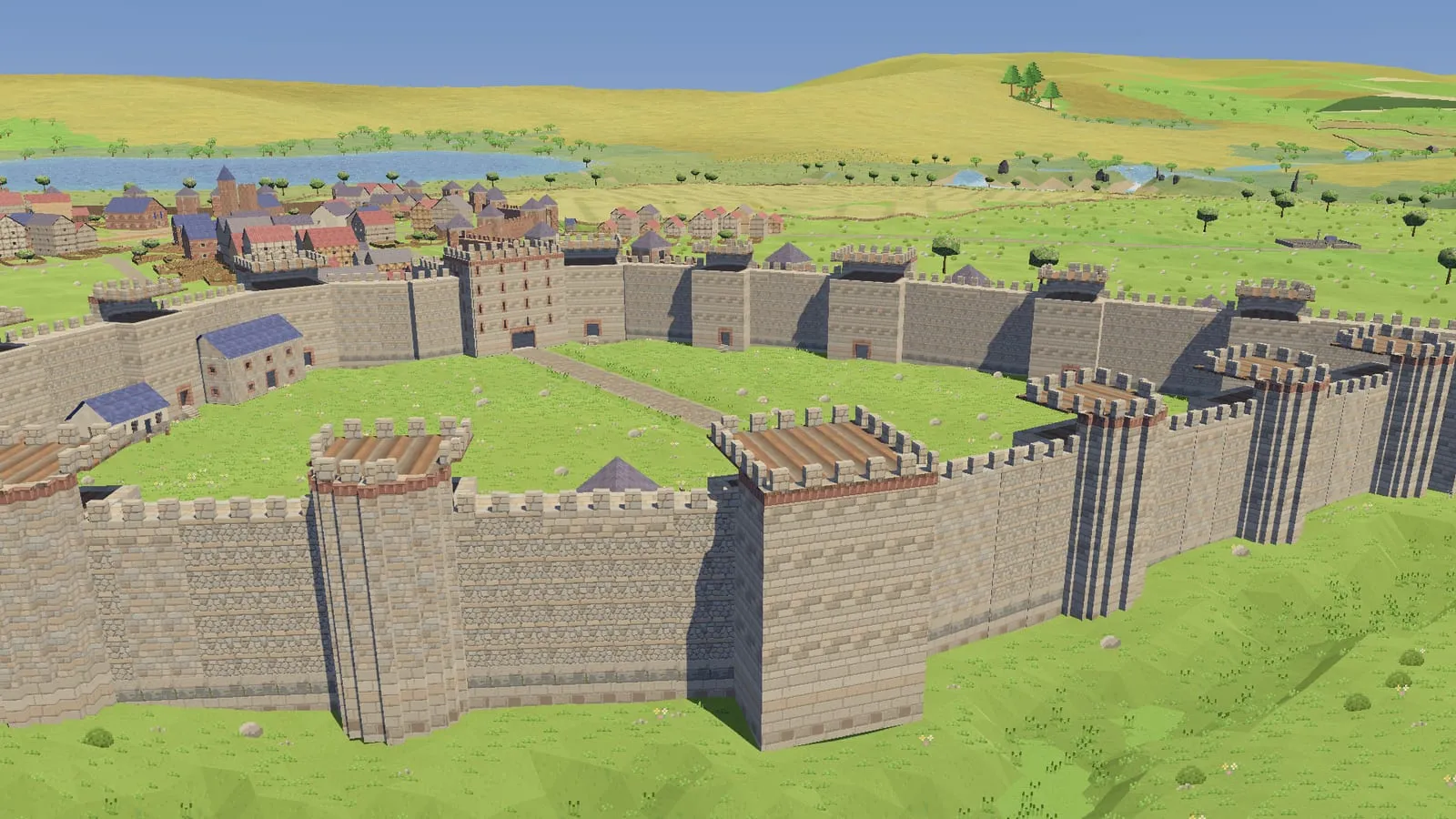
Each castle builds its own way. Half roof their towers with cones and pyramids, some put turrets on the corners of the keep and gatehouse, some run a stair turret up the keep, and some hang timber hoardings, more of them the richer the castle. Stairs climb to the wall walks and tower doors.
Inside
Section titled “Inside”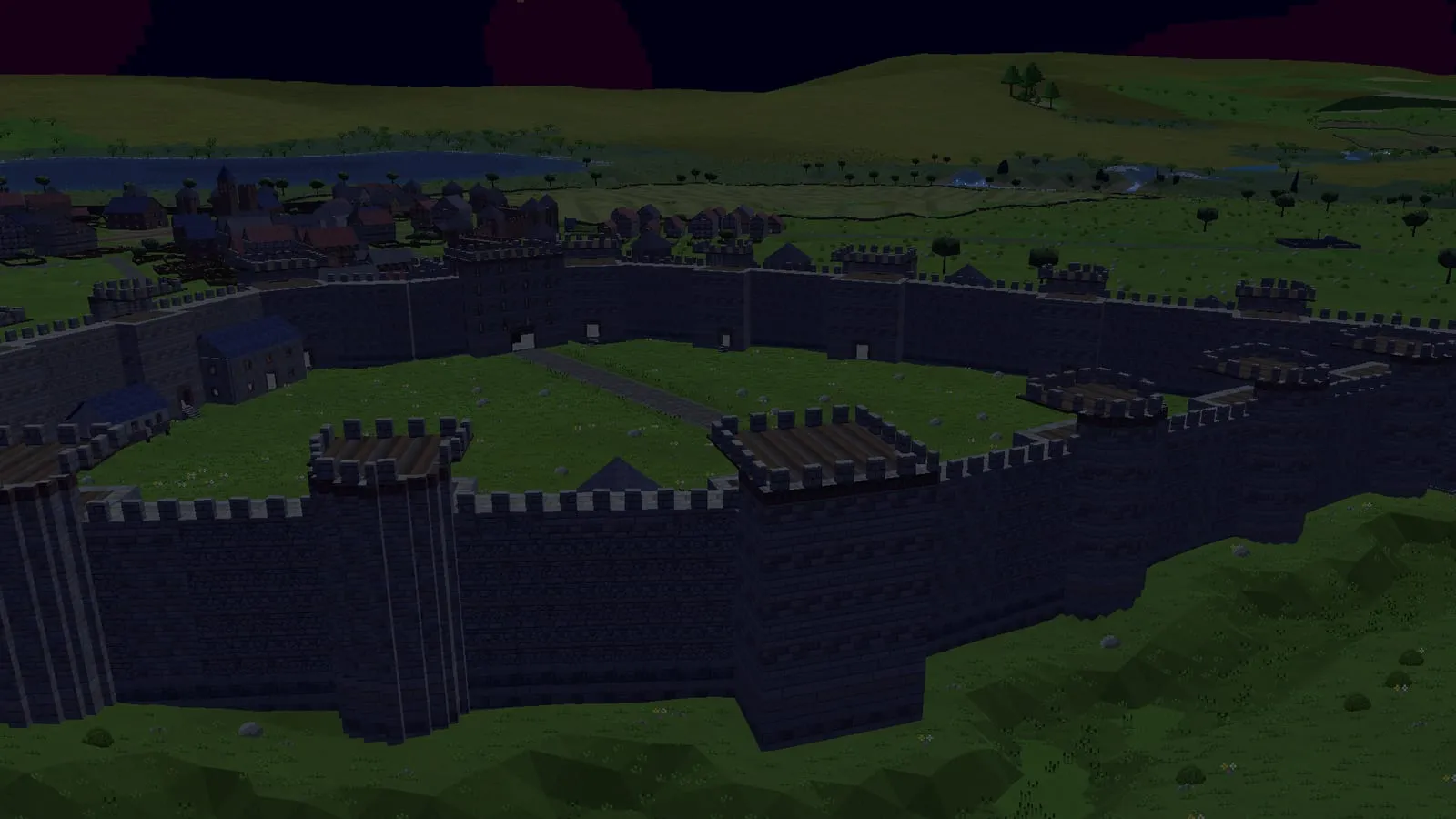
The bailey holds, as room allows: well, barracks, stables, smithy, storehouse, hall, temple, kitchens, mews, kennels, and more barracks, stables, halls and lodgings. What the walls have no room for stands outside by the road near the gate.
| Building | Tab |
|---|---|
| Barracks | Garrison |
| Keep hall | Jobs, Heads |
| Tiltyard | Tournament (where it holds the lists) |
| Smithy | Armourer, Weaponsmith |
| Stables | Stables |
A castle that stands alone has an inn by its road, “The (castle) Arms”. A castle has no gaol.
Moats and dungeons
Section titled “Moats and dungeons”Most castles have a ditch round their walls, dry or holding water, with a drawbridge at every gate that rises while the gate is shut. Under most keeps with a dungeon cell, a stair goes down to a dark chamber below the keep’s footing.
One to three castles start as ruins: a third of their walls fallen, the rest lowered, only the wells left inside.
The castellan
Section titled “The castellan”A castellan holds each castle and owes the king. Castles are held and fought over like towns. A castle sends out border raids and claims the towns and villages about it.
Buildings
Section titled “Buildings”Barracks, Castle smithy, Dungeon, Garderobe tower, Gate, Inn, Keep, Keep hall, Kennels, Mews, Stables, Storehouse, Temple, Tiltyard, Tower, Wall, Well, Workshop.