
Fauna
Horses
Section titled “Horses”
Every horseman rides his own horse, and so do you.
| Walk | Sprint | |
|---|---|---|
| Horse | 8 m/s | 20 m/s |
A horse leaps off the mark: past 5 m/s within 0.75 s and at 90% of its sprint within 3 s. It coasts to a stop, backs up at 2 m/s and turns wider the faster it goes. Every ten points of riding make a horse 2% faster and 3% handier. A tree’s trunk stops it as a wall does, but nothing slows it between the trees. A marsh or snowfield caps it at 0.7 of its sprint. It wades water up to 1.5 m deep and crosses ice 12 cm thick. Space in the saddle jumps a hedge, wall or fence: a wall at a trot, a hedge at a full gallop.
A horse has 200 hp, twice a man. Blows that land low on its rider (from a man on foot, an arrow or a javelin) wound it by half of what reached him. A horse brought down throws its rider and dies, and lies where it fell until the field is cleared. Out of a fight it mends.
Breath and rest
Section titled “Breath and rest”A horse has its own breath. Run out, it is blown: it only trots, at 55% of a gallop, and lathers. Spur a blown horse on and it may go lame (3% a second), and then it only walks. An army’s horses keep their own Rest. Spent, they hold back an army with riders. A stall at an inn gives them back a quarter an hour, and a coaching inn swaps spent horses for fresh ones at 40 silver each. See Inns.
Gear and food
Section titled “Gear and food”A horse wears barding, which stops 15 to 45% of the blows that come up at its rider and slows it 5%, and can carry saddlebags holding 25 kg. Couched in the saddle above 10 m/s, a lance strikes with the horse’s speed behind it. Braced spears stop horses.
Horses graze, except in winter, when each eats 2 kg of fodder a day from the train.
Getting horses
Section titled “Getting horses”Livery stables in towns sell spare horses at 1 gold 80 silver. A spare horse walks in the train and carries 100 kg like a mule. After a fight, the side that holds the field catches the loose horses, two minutes’ work for a man each.
Mules and oxen
Section titled “Mules and oxen”

Mules carry the train’s packs and oxen draw its wagons.
| Walk | Sprint | Carries | Price | |
|---|---|---|---|---|
| Mule | 6 m/s | 8 m/s | 100 kg | 1 gold |
| Ox wagon | 5 m/s | 7 m/s | 600 kg | 4 gold 10 silver |
An army goes at the pace of its slowest man or animal. Wagons need roads through forest. See Parties.
Farm animals
Section titled “Farm animals”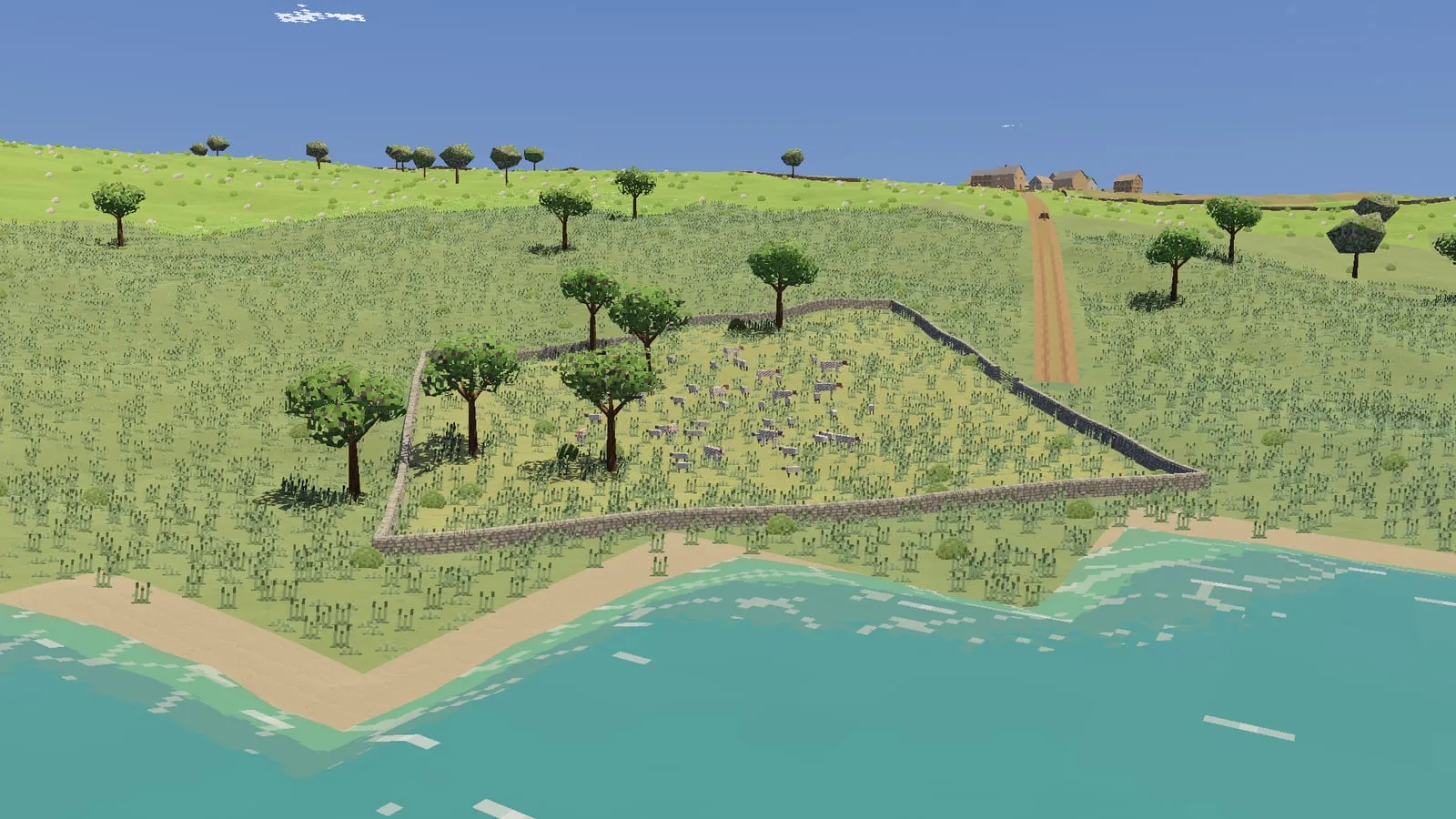
About one in six of a village’s farm folk is a herder where it has meadows. Each herder keeps one flock or herd:
| Animals | Size | Where |
|---|---|---|
| Cattle | 5 to 12 | Every third herder |
| Goats | 8 to 18 | Every other herder in uplands, over 400 m or in hills and mountains |
| Sheep | 16 to 36 | The rest |
| Pigs | 2 to 5 a sty | In gardens; out to the common wood in autumn |
| Hens | 4 to 9 a hen house | In gardens |
| Geese | 4 to 10 | On the village green |
A flock follows its herder out to pasture by day and is folded at night on the pasture nearest the village. While the herder is haymaking, harvesting or at a feast, and in winter, it stays on its fold. Hens and geese are shut in at night. Animals walk through gates and round hedges.
When an army comes, the village’s animals run in to their folds and the poultry is shut in.
Driving herds
Section titled “Driving herds”Raiders drive a village’s animals off into their train. A village’s herds grow back over a year. A driven herd slows the army to 4 m/s, or 6 sprinting, and is slaughtered for food, smallest animals first, when the train runs short.
In autumn, villages with their herds whole send drovers to market. See Travellers.
Wild animals
Section titled “Wild animals”| Animal | Where |
|---|---|
| Deer | Herds of a stag with hinds |
| Boar | Herds in the woods |
| Wolves | Packs in the hills and taiga |
| Birds | Flocks |
| Gulls, seabirds, seals | Coasts |
Each keeps to its own ground, away from towns and villages. Herds wander, rest, move lower in winter and have young in the warm half of the year. They walk in file when they move and graze when they stand. Deer and boar run from you.
At dusk the bats of some deep caves stream out of the mouth.
In the sky
Section titled “In the sky”| Creature | Where and when |
|---|---|
| Jellyflies | Herds of great see-through bells, from a cottage’s size to a manor house’s, drifting 50 to 800 m up with their tendrils trailing. They gather over the world trees, the goddess’s bones and the still lakes, drift off on the wind and work their way home again. They swarm in the spring bloom (days 4 to 14). By day they are pale and pearly; by night they glow soft blue or pink. |
| Starlings | At dusk in autumn and winter they gather over the reedbeds and the fields round the villages, fold into one great wheeling shape at sunset and drop into the roost within the hour. |
| Rooks | Round the villages’ trees all year: out to the fields at sunrise, back loud at sunset. |
| Geese | Long Vs crossing the disc, north in early spring (days 3 to 13) and south in autumn (days 35 to 45). |
| Crows and ravens | Circling a battlefield for two days after the battle, more the more fell. |
| Space whales | Once a year a pod about 9 km long swims in from the stars, grazes the cloud tops for a day or two and lazily makes its way back out. By night pale lights wink along their flanks. |
They are the look of the sky: nothing hunts them.