
Battles
Attacks come from four directions: left, right, overhead and thrust. Each has a windup, a strike and a recovery, and you can see which side a swing is coming from. A block stops only an attack from the side it covers, and only from in front. Releasing a held swing and pulling back before it strikes is a feint, and blocking during a windup feints into the block.
Speed adds harm:
| Closing speed | Harm |
|---|---|
| Standing | 1x |
| 14.4 m/s | 2x |
| Faster | Up to 3x |
| Pulling away | Down to 0.25x |
Every blow is a force: the blade’s weight at its swing’s speed, plus the striker’s travel. A cut from the left throws a man to the right, an overhead drives him down, and a thrust drives him back. A light blow makes him jolt, a harder one stumble him back, and one of 5 m/s or more knocks him off his feet. A rider holds his seat against half as much again, and past that is knocked out of the saddle. A braced spear takes a rider’s charge.
To cut a man down at the gallop, hold a left or right swing out to the side and let go as he comes up. A side cut sweeps round for 0.15 s and strikes the first man it reaches. In the saddle a side cut sweeps well down, through a man on foot’s chest.
Your blade leaves a pixel trail exactly where it went through the cut, thinning away over 0.35 s. A swing that lands turns it gold, so a miss shows how far short or wide it went.
Any horse over 9 m/s runs down hostile men on foot within 1.4 m: 20 harm at 10.8 m/s, about 37 at a full sprint. Spearmen brace instead, and a horseman galloping onto a braced spear is hurt as if trampled.
A man’s role is what his kit and seat make him (see Equipment).
| Role | HP | Notes |
|---|---|---|
| Infantry (spearman) | 100 | Longest reach; braces; does 4.25x to horsemen |
| Ranged (archer) | 80 | Shoots within 40 m every 1.8 s, 90% point blank down to 40% at full range, 30 harm |
| Cavalry (horseman) | 200 | Hits harder the faster it closes; tramples men on foot |
| Ranged cavalry (mounted archer) | Shoots from the saddle, out of the infantry’s reach |
Infantry beats cavalry, cavalry beats ranged and ranged cavalry, ranged beats infantry and outshoots ranged cavalry, and ranged cavalry beats infantry, at equal numbers and equal coin. On the map, a role hits one it beats twice as hard and one that beats it half as hard. A battle fought out on the map counts each man’s gear, skills and attributes, so a well-armed, skilled army hits harder and lasts longer than its numbers say.
The field
Section titled “The field”Far armies are banners on the map. When one comes within 300 m of the camera it turns into soldiers, and past 380 m it goes back to being a banner, with everything kept. In co-op every battle is resolved on the map.
Soldiers cross deep water by a bridge or ford within 500 m, and walls by an open gate. Hedges, walls and fences stop them, and they go round by the gates. Mud and snow slow men and horses, and rain and gusts make arrows fall short. Enemies and horses can shove men over the rim.
Orders
Section titled “Orders”A squad’s number key picks it and frees the pointer. Orders go to the squads picked:
| Key | Order |
|---|---|
| F1 | At will |
| F2 | Follow me |
| F3 | Advance 10 m |
| F4 | Charge |
| F5 | Hold |
| F6 | Archers fire, or hold fire |
With a squad picked, left click an enemy squad to attack it, or right drag to place your men.
Squad leaders and banners
Section titled “Squad leaders and banners”Every squad has a leader, paid twice. His squad answers an order in 2.5 s, less 0.2 s a point of his warfare, 0.5 s at best. When he falls the squad wavers 3 s before the next best takes over, and the army loses 0.05 morale.
Every squad of two or more flies a banner with its device in the army’s colour. A banner drops where its bearer falls, and the nearest man within 25 m goes for it. The army loses 0.1 morale while it is down, gets 0.05 back when its own take it up, and loses 0.1 again if the enemy carries it off.
Formations
Section titled “Formations”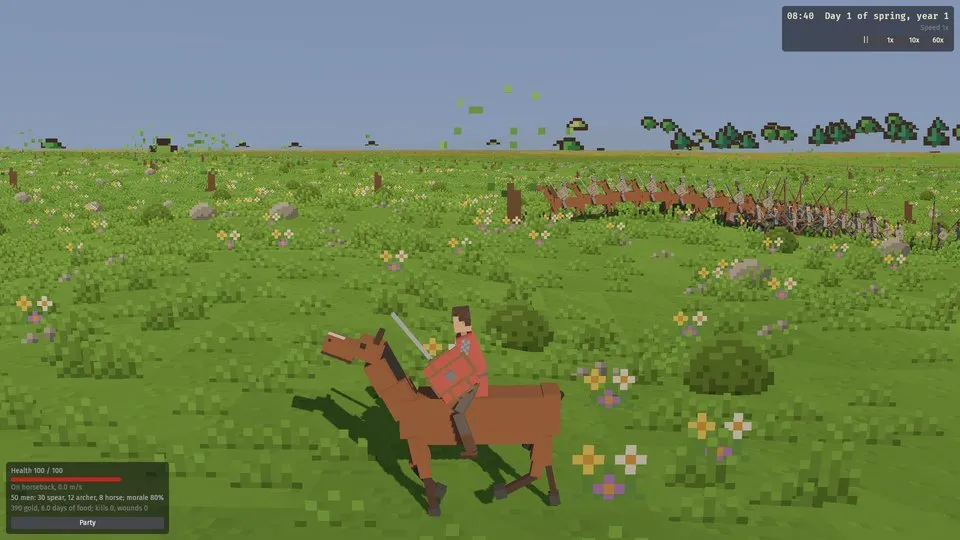
A plan sets how the squads stand: each squad a box shaped as a line, column, wedge, square or mob. With one squad picked, right drag to draw: drag a box’s side to widen or narrow it, or end a drag by another box’s edge to dock it there. N pins a squad’s ranks.
M and B take up the marching and battle formations. Ctrl+M and Ctrl+B keep the current plan as that formation. The Squads tab keeps up to nine plans by name.
Armies with nobody commanding them form up by doctrine when an enemy comes within 400 m. They charge at 1.5 to one and run below 0.6 to one.
Morale
Section titled “Morale”Armies start at 0.8 morale. Losses cost it: losing a share of the army costs 0.75 times that share. Hunger and unpaid wages cost it too. Below 0.3 an army breaks and runs, or below 0.45 once it has lost two squad leaders.
A routed army runs for the nearest friendly town or castle within 8 km, else its train, and rallies within 150 m of it. Elsewhere it rallies at 0.6 morale once no pursuer is within 1.2 km. A pursuer chases only by day, under 0.75 weary and within 3 km of its own train. After dark armies fight on only if one is set on the other.
Weariness
Section titled “Weariness”Men and horses tire by Breath (seconds: sprints, swings, blocks) and Rest (hours: the march and the fight). Winded men swing slower and weaker and their blocks break; worn-out men deal up to 30% less harm and take up to 25% more. All of it is on Fatigue.
H makes camp where you stand: tents, fires, horse lines, a wagon park and a sentry ring. It goes up in half a game hour and comes down as fast. F by a fire lights it or puts it out. A fire burns 5 kg of wood an hour, or none within 300 m of woods. At night a lit fire is seen 8 km off.
| Rest stop | Sleeps under its roofs |
|---|---|
| Inn | 12 |
| Guesthall | 20 |
| Coaching inn | 30 |
| Village (quartered) | 4 a house or barn |
| Town | 1 for every 8 citizens, at least 20 |
| Castle | 40 |
| Seat | 100 |
The rest camp beside it. Quartering on your own realm’s village eats its grain and costs its goodwill. Quartering on a hostile village is a raid. A camp kept on the same ground three days falls sick: 2% of the men outside fall badly wounded each dawn.
Wounds
Section titled “Wounds”Not every man who goes down is dead. A glancing last blow leaves a light wound, a solid one a bad wound, and a killing one a corpse. Armour softens it a step.
The lightly wounded fight on at 70% of their hit points. The badly wounded ride in the train if it has 75 kg of room each, or walk at the back holding the army to half pace. Each day the army’s best healer tends ten men a point of medicine: a light wound heals in two days and a bad one in six. Untended, a light wound turns bad 15% of days and a bad one kills 25% of days.
| Where | Healing |
|---|---|
| By a friendly town or village | 1.5x |
| Inside walls, or in an inn’s beds | 2x |
| Bandages in the train | 1.5x |
| Herbs in the train | 1.5x |
On the map, of every four who fall, two die, one is badly wounded and one lightly.
Bleeding
Section titled “Bleeding”A blow that gets through to flesh bleeds: the harder it lands the more, a thrust 1.3 times a cut, much less under mail or plate, and not at all from a glance or a block. A small cut clots by itself. A bad one, a blow of about a third of a man’s hit points unarmoured, bleeds on, sapping hit points, until he has been out of the fight for five seconds and is bound, which takes 30 s less 8% for each point of his side’s best medicine.
A bleeding man leaves a drop of blood every 1.2 m he goes or 1.5 s he stands, so a wounded man running off leaves a trail, and his legs soak red. You bleed by the same rule and get no breath back while you do; if you bleed out you fall badly wounded. Blunted bouts in the lists open no wounds.
Blood shows as much as the Blood setting allows (Options, Gameplay: off, some or full). A blow throws a spurt of droplets the way it threw the man, the part struck stains red and darkens as it dries, and a pool spreads under the dead. Blood darkens on the ground over a few minutes, shows darker on snow and fainter on grass or mud. It lands on decks, floors and cave floors too. The weather washes it out slowly, never under a roof, and standing water 0.3 m deep washes it off.
After the fight
Section titled “After the fight”The winner takes half the beaten army’s coin when it routs and the rest if it is wiped out, plus 8 silver for every man killed. Its train is left standing where it was beaten: all of a wiped-out army’s, and a routed one’s wagons, gear, goods and the food its mules cannot carry. Horses killed lie dead where they fell. A side holds the field after a quiet minute with no fighting enemy near. Riding alone, with no men yet, you count as one man, so you hold the field where you cut your foes down. Only the holder gathers it: G sends picked men to strip the dead, or loots a body as the rider. Burying your dead under mounds lifts morale. A field nobody holds is picked over, a third a day.
Men of a routed army caught on foot by the army they broke from yield, about a third of them, and stand where they gave up until gathered. The gather order (G) sends men to rope them, a minute a man, and sends the train to take in a left train: any army’s train within 40 m of one takes it, its old owner’s too. Yielded men with no hostile army within 120 m run off. Prisoners march roped behind the train, eat its food and need a guard of one man to five, or half of those past the guard slip away each dawn. Captives held three days can be offered a place in the ranks.
Walls, breaches and fire are on Sieges.