
Harvest
Fields
Section titled “Fields”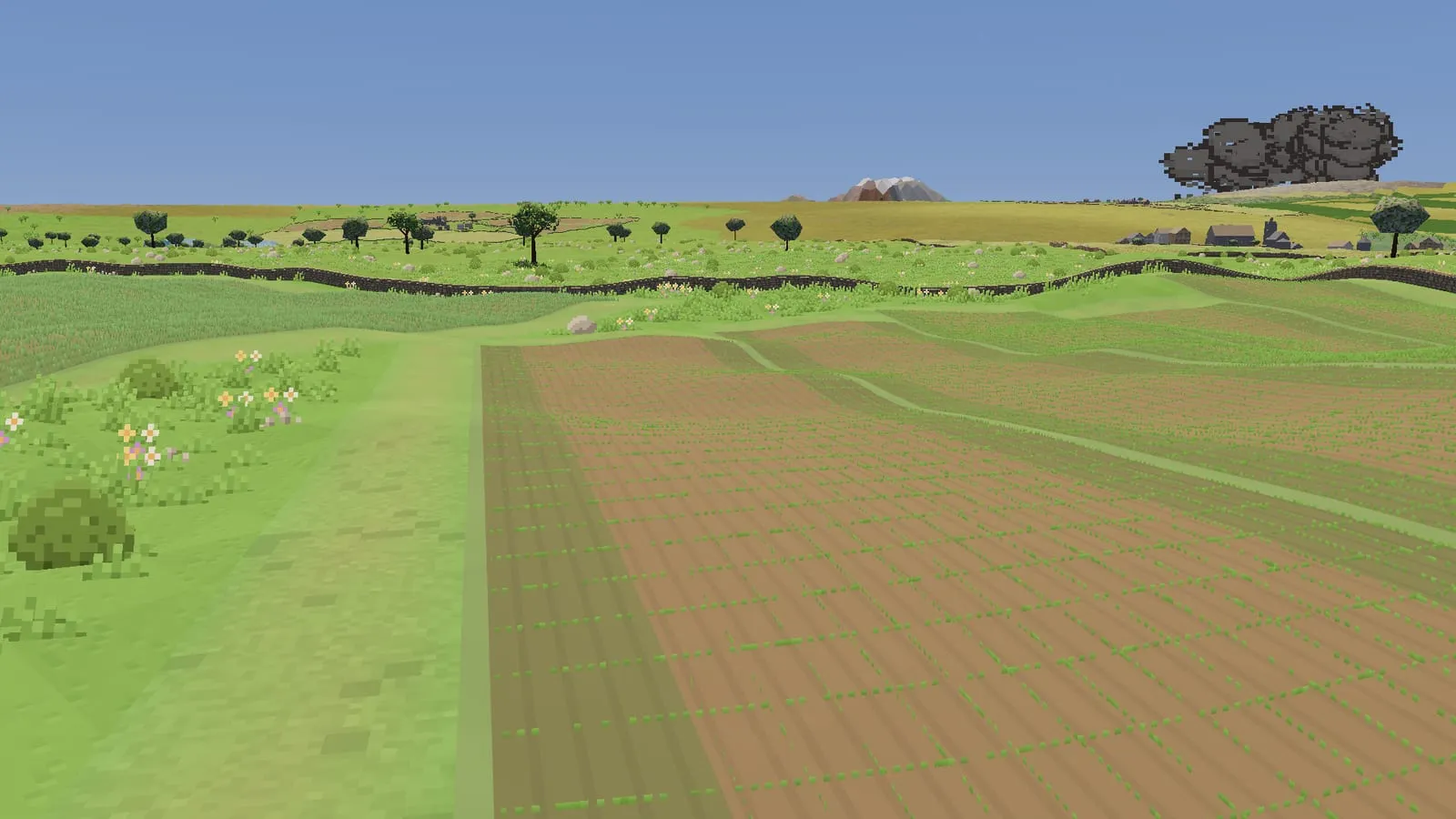
A village farms two or three great open fields round its houses, out to about 500 m. A village of under 12 buildings has two. Each field is shared out in furlongs of long strips, about 200 m by 10 to 20 m, lying with the land. A town has three great fields outside its walls, and a manor two round its hall.
Past the fields lie meadows by the water. Six in ten are hay meadows, mown in early summer, and the rest are pasture. Past those, a village’s land runs on halfway to its nearest neighbour, at most 3 km, as common pasture on open ground or common wood where trees grow thickly. Pigs go to the common wood in autumn.
Fields are hedged, or walled in dry stone on hills, mountains, snow, tundra, steppe, desert, shrubland or above 400 m. Hedges, walls and fences stop men and horses, who pass only by the gates. A wicket gate lets a man on foot through but not a horse. Field edges run in straight lengths at any angle, keep off springs, ponds and water, and leave a gap where a road crosses. Each field has one 3 m gate, where a lane, road or track comes nearest. Gardens are fenced with wattle and entered by a wicket.
Hedges blossom white in late spring and bear red haws into winter. Corn comes up green, stands tall and sways in the wind, turns gold, and once cut stands as stubble with sheaves in stooks. Fallow flowers in summer.
Rotation
Section titled “Rotation”Each great field turns as one:
| Fields | Rotation |
|---|---|
| Three | Winter corn, then spring corn, then a year fallow, grazed by the sheep |
| Two | Corn and fallow by turns |
What is sown follows the land: wheat in the temperate lowlands, rye and barley where it is cold or high, oats and flax on wet ground, barley and beans where it is dry. Each crop has its own page: Wheat, rye, oats, beans, barley, flax.
The year in the fields
Section titled “The year in the fields”| Days | Work |
|---|---|
| 5th to 12th of summer | Hay time; wains bring the hay home |
| 1st to 8th of autumn | The reaping; wains bring the sheaves home |
| 9th of autumn | Harvest Home, the harvest supper |
Fields are ploughed bare through winter, green in spring, gold in summer and stubble after the reaping.
Every village keeps a barn. A fair year brings in 1.7 years of its folk’s bread. A two-field village under 36 folk brings in less. Rain near the disc’s usual amount through spring and summer does best, and drought or a drowned summer does worse. Each country about 15 km across has its own luck, and one year in nine is blighted to half. Burnt crops and lost folk reap less. Under six tenths of a fair year, the harvest has failed.
The folk eat 1 kg a day each from the barn, and so do armies quartered with them. When the reaping is done:
- A tenth goes to the Temple as tithe.
- The lord’s dues go by wagon to the castle the village owes: a tenth from a free village, up to three tenths from a bound one.
- The cart sells what is over next year’s bread and 15% more, or takes coin to buy grain when the barn is short.
Standing by a village, the screen shows what its barn holds, how its last harvest went and how much of its crop is burnt.
Burning
Section titled “Burning”By a hostile village with crops standing or grain in its barn, you can Burn the fields. Its standing crops burn, your train takes what grain it has room for, the rest burns, and the village’s goodwill is gone. Its charred fields stay black until the spring sowing.
A village with a bare barn loses two in a hundred of its folk a day, up to a quarter, and has as many fewer recruits. Fed again, it makes them up over a year.
Traffic through the year
Section titled “Traffic through the year”| Season | Village carts | Caravans |
|---|---|---|
| Spring | 0.6x | 1x |
| Summer | 1x | 1.3x |
| Autumn | 1.6x | 1.2x |
| Winter | 0.35x | 0.5x |
Both go out twice as often while their town’s fair is near. Three lords in four winter at home.